Short answer: BATELI PET manufactures IATA-compliant airline pet carriers with MOQ from 50 pcs, 7-15 day sampling, and 30-45 day production. As a 20+-year BSCI/SGS/ISO 9001 certified factory exporting to 50+ countries, we provide compliance documentation including REACH, RoHS and airline dimension verification reports. This guide covers 2026 IATA regulations for importers sourcing airline-approved pet carriers.
Air travel with pets is one of the fastest-growing segments of the pet products industry, and 2026 brings renewed focus on safety, compliance, and documentation. For importers, brands, and retailers selling airline-approved pet carriers, the stakes are high: a carrier that fails IATA (International Air Transport Association) guidelines or lacks proper compliance documentation can be refused at check-in, detained at customs, or pulled from retail shelves. This guide covers the IATA air travel container requirements, carry-on versus checked baggage rules, importer compliance essentials, and the most common reasons pet carriers are detained or returned — so you can source and sell with confidence.
IATA Air Travel Container Requirements
The IATA Live Animals Regulations (LAR) set the global standard for pet travel containers. While individual airlines may impose additional restrictions, all IATA-member carriers follow these baseline requirements. For importers and manufacturers, understanding these requirements is essential for designing and marketing “airline approved” carriers.
Container Size and Space
The container must be large enough for the animal to stand, turn around, and lie down in a natural position. IATA provides specific size formulas based on the animal’s measurements: the container height must allow the animal to stand erect without its ears touching the top (for breeds with erect ears, add extra height); the length must equal the animal’s body length from nose to base of tail plus half the height of the front leg; and the width must be at least twice the animal’s shoulder width. Carriers that are too small are the single most common reason for refusal at the airport check-in counter.
Ventilation Requirements
IATA requires ventilation on at least three sides of the container for checked baggage, with the majority of ventilation on the upper half of the container walls. For carry-on carriers, ventilation on two sides is generally accepted, though three sides is preferred. Ventilation openings must be small enough to prevent the animal from sticking its paws or snout through, yet large enough to provide adequate airflow. Mesh panels should be reinforced and tear-resistant — a pet that claws through mesh during a flight creates an immediate safety and escape risk.
Structural Strength and Security
Checked pet containers must be rigid, sturdy, and leak-proof. The container must have a secure locking mechanism that cannot be accidentally opened — IATA recommends metal spring-loaded locks or twist-lock fasteners rather than simple zippers for checked travel. The floor must be solid and leak-proof, with an absorbent liner. Handles must be sturdy enough for baggage handlers to lift the container safely, and the container must be able to withstand being stacked with other luggage (for hard-sided models). Wheels, if present, must be removable or lockable to prevent the container from rolling on the tarmac.
Labeling and Identification
Every checked pet container must display: the animal’s name and owner contact information, “Live Animal” labels on at least two sides, orientation arrows (“This Way Up”) on all four sides, and a feeding and watering schedule for flights over a certain duration. The container must also have a food and water bowl attached to the inside door, accessible without opening the container. For importers, ensuring that your carrier design includes attachment points for bowls and labels is a critical design consideration.
Carry-On vs. Checked Baggage: Key Differences
Pet carriers fall into two categories for air travel: in-cabin carry-on and checked baggage (cargo hold). The requirements differ significantly, and many carriers are designed for one or the other — not both.
In-Cabin Carry-On Carriers
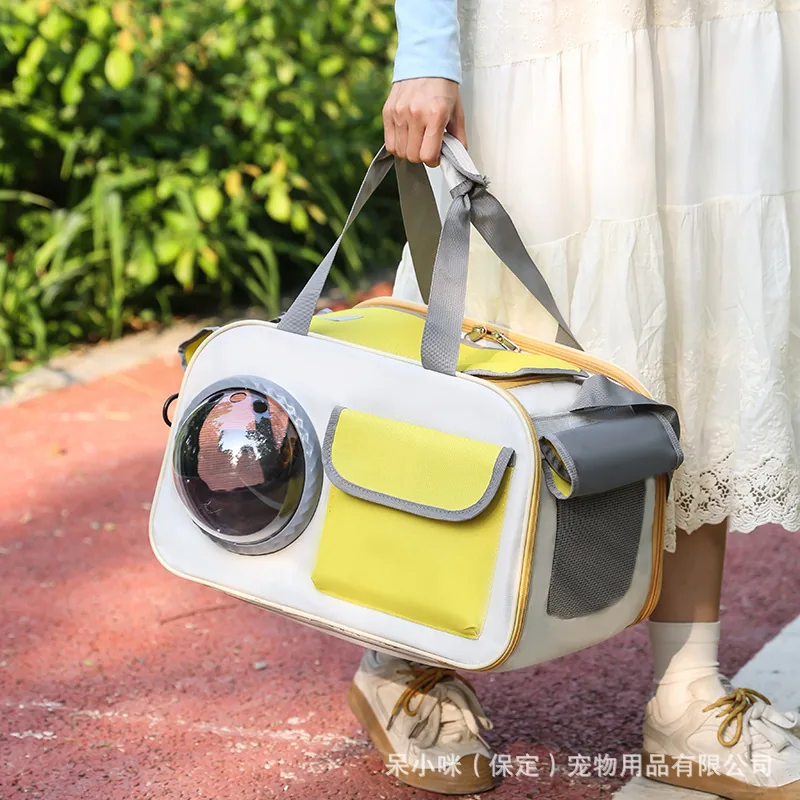
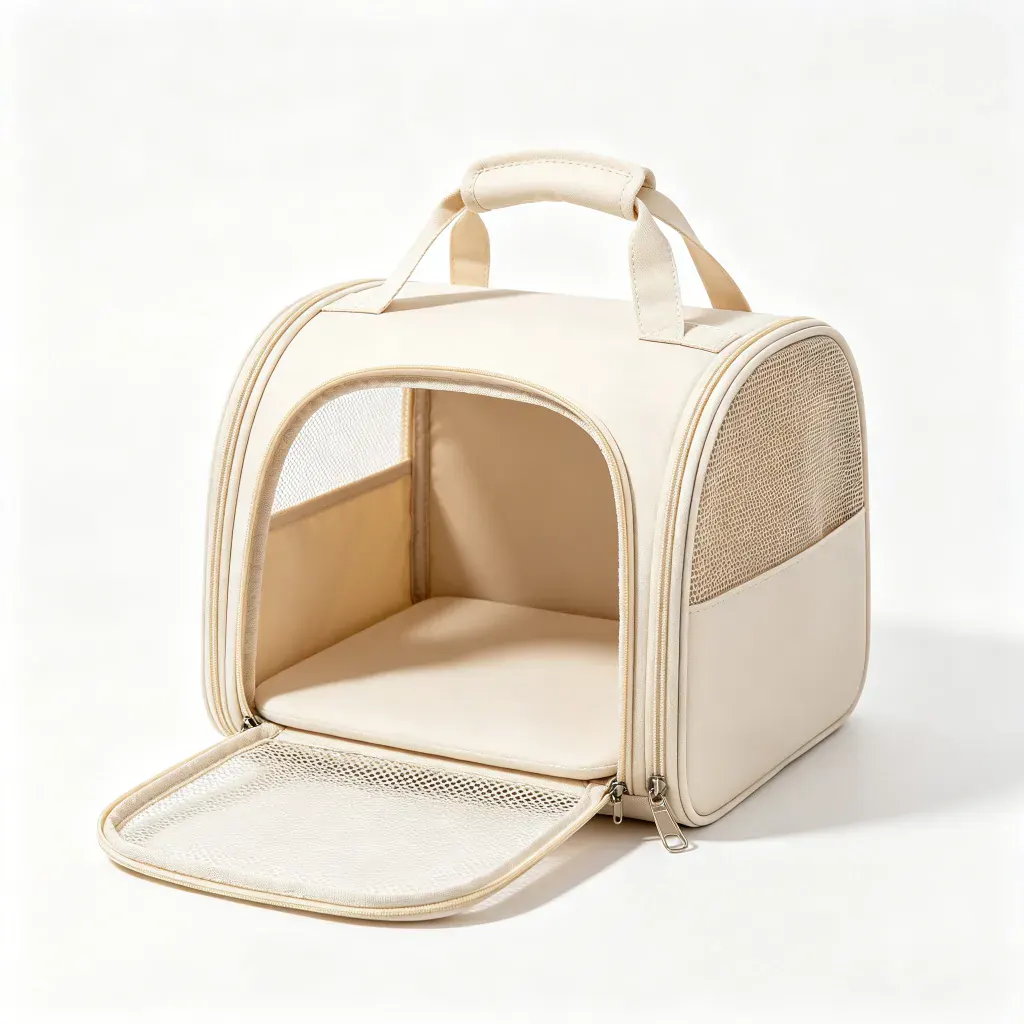
Most major US and international airlines allow small pets (cats and small dogs, typically under 8–10 kg including the carrier) to travel in the cabin for a fee. The carrier must fit under the seat in front of the passenger, which means maximum dimensions are typically around 45 cm × 33 cm × 22 cm (18″ × 13″ × 9″), though exact limits vary by airline and aircraft type. Soft-sided carriers are preferred for in-cabin travel because they are more flexible and can conform to under-seat spaces. The carrier must remain under the seat for the entire flight, and the pet must remain inside. Mesh ventilation on at least two sides is required, and the carrier must be leak-proof and escape-proof.
Checked Baggage (Cargo Hold) Carriers
Larger pets, or pets on flights where in-cabin travel is not permitted, must travel in the cargo hold as checked baggage or as air cargo. Checked pet carriers must be hard-sided (rigid) and meet all IATA container requirements for strength, ventilation, locking, and labeling. Soft-sided carriers are generally not accepted for checked travel because they cannot withstand the rigors of cargo handling. The cargo hold environment is louder, darker, and subject to temperature and pressure changes, so the carrier must provide a secure, comfortable, and well-ventilated space. Some airlines restrict brachycephalic (short-nosed) breeds from checked travel due to respiratory risk — importers should be aware of these restrictions when marketing carriers for specific breeds.
Important note: Airline pet policies are subject to change, and specific requirements vary by airline, aircraft type, route, and destination country. Importers and brands should always direct customers to verify current requirements directly with their airline before travel. Marketing a carrier as “airline approved” should be accompanied by clear language that approval is subject to individual airline policies.
Importer Compliance Essentials for 2026
Beyond airline-specific requirements, importers of pet carriers must ensure their products meet regulatory compliance standards in their target markets. Non-compliant products can be detained at customs, refused entry, or subject to recall. Here are the key compliance areas for 2026:
US Market Compliance
For the United States, pet carriers are generally regulated as consumer products. Key compliance areas include: CPC (Children’s Product Certificate) if the product could be used by or marketed to children (some pet carriers are dual-use); ASTM F963 compliance for any components that could be considered toy-like; CPSIA (Consumer Product Safety Improvement Act) requirements for lead and phthalates in surface coatings and plastic components; and proper labeling including country of origin, care instructions, and safety warnings. The US Consumer Product Safety Commission (CPSC) has increased enforcement on pet products in recent years, so documentation must be complete and readily available.
EU Market Compliance
For the European Union, pet carriers must comply with REACH (Registration, Evaluation, Authorisation and Restriction of Chemicals) regulations for chemical substances in materials and coatings; RoHS (Restriction of Hazardous Substances) for any electronic components (e.g., built-in fans, lights, or GPS trackers); and the General Product Safety Regulation (GPSR) which requires that all products placed on the EU market are safe. Importers must maintain a technical documentation file, ensure proper CE marking where applicable, and designate an EU responsible person. The EU’s stricter chemical regulations mean that fabric dyes, plastic components, and metal hardware must all meet REACH substance restrictions.
Labeling and Documentation
All pet carriers should include: country of origin labeling (required by US Customs and EU regulations); material composition labels; care and cleaning instructions; safety warnings (e.g., “Not for use as a child restraint,” “Do not leave pet unattended in vehicle”); weight capacity ratings; and manufacturer or importer contact information. For airline-marketed carriers, include a statement that the carrier meets IATA guidelines but that airline approval is subject to individual carrier policies. Maintaining complete compliance documentation — including test reports, certificates, and supplier declarations — is essential for fast customs clearance and for responding to any regulatory inquiries.

Common Detention and Return Reasons — and How to Prevent Them
Even with a well-designed carrier, importation and retail issues can arise. Based on our experience shipping to 50+ countries, these are the most common problems and their solutions:
- Missing compliance documentation: Customs authorities may detain shipments that lack CPC, REACH, RoHS, or test report documentation. Prevention: Request all compliance documents from your manufacturer before shipment, and include copies with the shipping paperwork.
- Incorrect or missing country of origin labeling: Products without proper “Made in China” (or applicable country) labels can be refused or relabeled at the importer’s expense. Prevention: Verify labeling during pre-shipment inspection, and ensure labels are securely affixed and cannot be easily removed.
- Carrier size does not match advertised dimensions: Retailers and customers frequently return carriers that do not fit under airline seats or do not accommodate their pet. Prevention: Clearly state both external and internal dimensions in product listings, and include a sizing guide based on pet measurements.
- Zipper or latch failure: Escape-proof zippers and latches are critical for air travel. A carrier with a faulty zipper is a safety hazard and a returns magnet. Prevention: Specify heavy-duty, rust-resistant zippers with anti-escape designs, and conduct zipper durability testing during QC.
- Mesh tearing or fraying: Reinforced mesh is essential for airline carriers. Thin or poorly attached mesh can tear during transit or from pet clawing. Prevention: Specify tear-resistant, reinforced mesh panels and include mesh strength testing in your QC protocol.
BATELI PET: Your Airline-Compliant Manufacturing Partner
At BATELI PET, we have over 20 years of experience manufacturing pet carriers for brands and importers worldwide. Our 2,600 m² factory and 180+ skilled workers produce 80,000+ units per month, with a four-stage QC process and a defect rate below 0.8%. We hold BSCI, SGS, and ISO 9001 certifications, and our products comply with REACH and RoHS standards.
For airline-compliant carriers, we offer:
- IATA guideline-aligned designs: Hard-sided carriers with proper ventilation ratios, secure locking mechanisms, leak-proof floors, and bowl attachment points.
- Soft-sided in-cabin carriers: Flexible, under-seat-compatible designs with reinforced mesh panels and escape-proof zippers.
- Full compliance documentation: CPC, ASTM F963, REACH, and RoHS documentation provided with every order.
- OEM and ODM customization: OEM starting at 50 pieces per color/style, ODM at 100 pieces per model. Logo samples in 3–5 days, custom material/color samples in 7–10 days, full ODM design samples in 10–15 days.
- Amazon FBA and global shipping: FBA prep, labeling, and DDP shipping to fulfillment centers and distribution hubs worldwide.
Our Alibaba International store maintains a 4.4/5 rating with 165+ verified reviews, and we export to 50+ countries. Browse our full pet carrier collection to see our airline-compliant product range, or learn more about our OEM and ODM customization services to design a carrier that meets your brand’s specific airline compliance and market requirements.
Frequently Asked Questions
Are all pet carriers airline approved?
No. There is no universal “airline approved” certification. Each airline sets its own carrier size, weight, and design requirements, and these can vary by aircraft type and route. Carriers that meet IATA Live Animals Regulations guidelines are generally accepted for checked travel, and soft-sided carriers that fit under the seat are typically accepted for in-cabin travel. Always verify current requirements with the specific airline before travel.
What is the difference between IATA requirements and airline-specific requirements?
IATA Live Animals Regulations set the global baseline standard for pet travel containers, covering ventilation, size, strength, locking, and labeling. Individual airlines may impose additional or stricter requirements — for example, some airlines only accept hard-sided carriers for checked travel, some have specific maximum dimensions for in-cabin carriers, and some restrict certain breeds. IATA compliance is necessary but not always sufficient; always check the airline’s specific pet policy.
What compliance documents do I need to import pet carriers into the US and EU?
For the US market: CPC (Children’s Product Certificate) if applicable, ASTM F963 compliance documentation, CPSIA test reports for lead and phthalates, and country of origin labeling. For the EU market: REACH compliance declarations, RoHS documentation for electronic components, GPSR (General Product Safety Regulation) technical documentation, CE marking where applicable, and an EU responsible person designation. BATELI PET provides all required compliance documentation with every order.
Can soft-sided carriers be used for checked baggage on airplanes?
Generally, no. Most airlines require hard-sided (rigid) carriers for checked baggage travel in the cargo hold, because soft-sided carriers cannot withstand the rigors of baggage handling and cargo stacking. Soft-sided carriers are designed for in-cabin carry-on travel, where they remain under the passenger’s seat and are not subject to cargo handling. Always verify with the specific airline, as policies may vary.
Need IATA-Compliant Pet Carriers for Your Brand?
Request a Free Quote | WhatsApp: +86 133 8657 5871 | pet@batelipet.com
nnnn