Short answer: Airline pet carrier rules differ by region: IATA sets cabin dimensions, USDA governs US live-animal transport, and the EU enforces REACH/RoHS chemical safety. BATELI PET supplies carriers compliant to all three, with MOQ from 50 pcs and 30-45 day production.
Understanding IATA, USDA, and EU airline pet carrier rules is essential before you manufacture, import, or sell travel pet carriers. Each regime has distinct requirements — and getting them wrong means rejected shipments, customs holds, or airline refusals at the gate. As an OEM/ODM pet carrier manufacturer exporting to 50+ countries with MOQ from 50 pcs, we’ve compiled the complete 2026 compliance matrix below.
The key takeaway: IATA sets global air transport standards, USDA governs US entry for pets and products, and the EU enforces strict material and welfare rules. A carrier that meets all three can sell worldwide — but most only meet one. Here’s how to tell the difference.
What Are IATA, USDA, and EU Pet Carrier Regulations?
These three regulatory bodies govern different aspects of pet travel, and their requirements overlap in some areas while diverging sharply in others.
IATA (International Air Transport Association) represents 300+ airlines and publishes the Live Animals Regulations (LAR), which define container requirements for air transport. IATA rules focus on carrier dimensions, ventilation, security, and animal welfare during flight.
USDA (United States Department of Agriculture) regulates the import of live animals into the US and sets standards for pet carriers used in commercial air travel. USDA requirements emphasize animal health documentation, crate construction, and leak-proof flooring.
EU (European Union) enforces the Pet Travel Scheme (EU Regulation 576/2013) plus product safety directives (GPSR, REACH) that apply to pet carriers sold in the EU market. EU rules are the most stringent for material safety and labeling.
IATA vs USDA vs EU: Complete Compliance Matrix 2026
| Requirement | IATA (LAR) | USDA | EU |
|---|---|---|---|
| Carrier type | Rigid plastic or fiberglass crate for cargo; soft-sided for in-cabin (airline-specific) | USDA-approved rigid crate for cargo; soft carriers allowed in-cabin per airline | Both rigid and soft carriers accepted; must meet airline dimension limits |
| Ventilation | ≥14% open area on 3 sides; metal mesh or bars (no plastic mesh for cargo) | Ventilation on at least 3 sides; minimum 1 inch clearance from crate walls | Adequate ventilation required; no specific percentage mandated by EU (follows IATA/airline) |
| Size rule | Pet must stand, turn, and lie down naturally; head clearance ≥5 cm (2 in) for rigid crates | Pet must stand and turn around; enough room to lie down comfortably | Follows IATA sizing; airlines may impose stricter in-cabin limits (typically 40×25×25 cm) |
| Closure/security | Metal bolts or spring-loaded door; no plastic clips; must be escape-proof | Secure latch; crate must be sealed with cable ties or metal fasteners for cargo | Secure closure required; zipper locks recommended for soft carriers |
| Leak-proof floor | Required; absorbent pad or tray must contain spills | Required for all cargo shipments; absorbent material mandatory | Required; waterproof base recommended |
| Material safety | No toxic materials; metal hardware preferred | Non-toxic materials; no exposed sharp edges | REACH & RoHS compliance mandatory; GPSR general product safety applies |
| Labeling | “Live Animal” labels (2 sides), “This Way Up” arrows, owner contact info | “Live Animal” sticker required; food/water instructions for flights >12 hrs | CE marking not required for carriers, but GPSR requires manufacturer info & safety warnings |
| Pet documentation | Health certificate, vaccination records attached to crate | USDA-accredited vet health certificate (VS Form 7001); rabies vaccination proof | EU pet passport or Annex IV health certificate; microchip (ISO 11784/11785); rabies vaccine |
| Temperature limits | Airlines may embargo pets when ground temp >29.4°C (85°F) or <7.2°C (45°F) | Animal and Plant Health Inspection Service (APHIS) monitors temperature; embargo rules apply | No specific temperature mandate; follows airline/IATA embargo rules |
| Snub-nose (brachycephalic) breeds | Many airlines refuse brachycephalic dogs/cats in cargo due to respiratory risk | USDA recommends extra ventilation; some airlines ban entirely | EU airlines may require larger crates or refuse brachycephalic breeds |
How to Choose an IATA-Compliant Pet Carrier
For cargo transport, IATA requires rigid plastic or fiberglass crates with metal door hardware, ventilation on three sides (minimum 14% open area), and a leak-proof floor. The crate must be large enough for the pet to stand, turn around, and lie down in a natural position — with at least 5 cm (2 inches) of headroom.
For in-cabin travel, IATA doesn’t mandate a specific carrier type, but individual airlines set their own limits. Most major airlines (Delta, United, American, Lufthansa, Air France) require soft-sided carriers no larger than 45×35×25 cm (18×14×10 in) that fit under the seat. The carrier must be leak-proof and ventilated, and the pet must fit comfortably without touching the top.
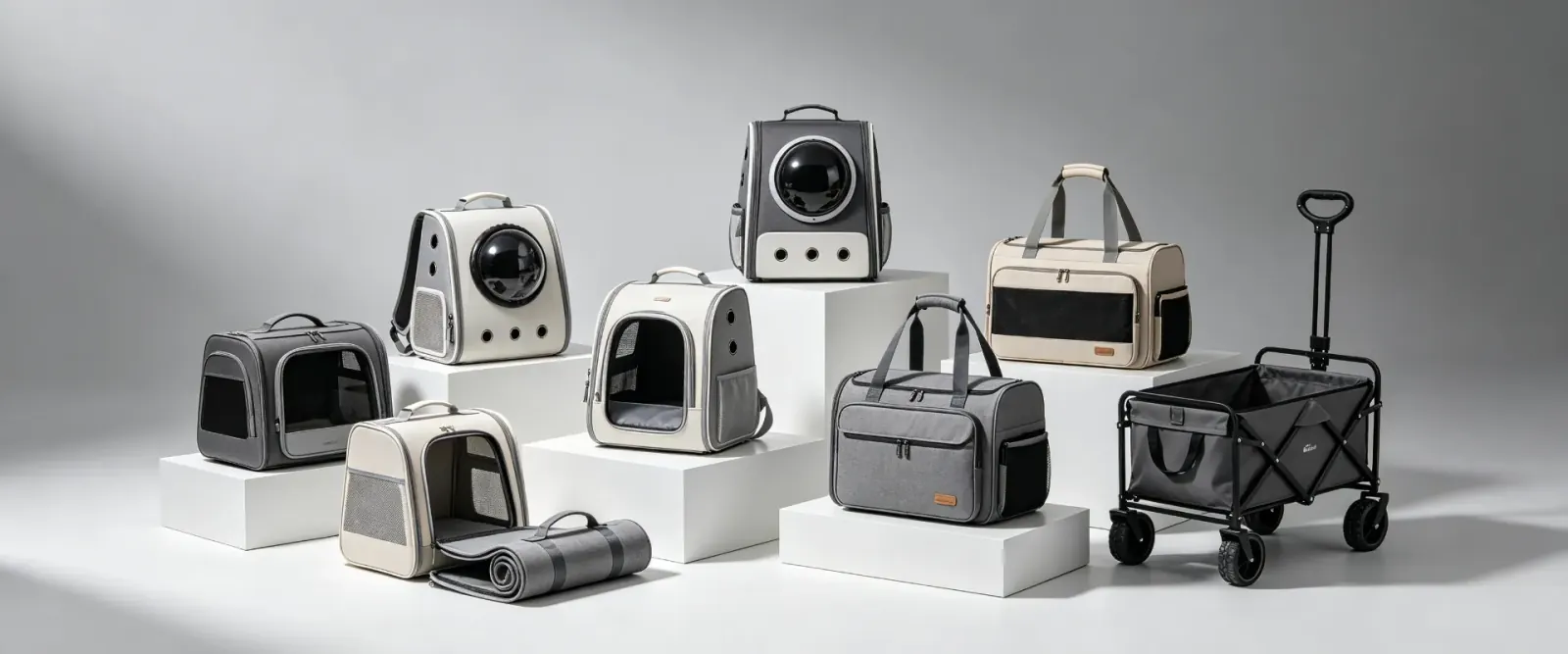
When manufacturing custom pet carriers, we design for the strictest airline in your target market. For example, our airline-approved backpack series meets both IATA cargo standards and the most restrictive in-cabin limits used by European carriers.
USDA Requirements: What US Importers and Travelers Need
The USDA’s Animal and Plant Health Inspection Service (APHIS) regulates pet entry into the United States. For pet carriers specifically, USDA requirements overlap with IATA but add several US-specific conditions:
- Health certificate: A USDA-accredited veterinarian must issue a health certificate (VS Form 7001) within 10 days of travel for international arrivals.
- Rabies vaccination: Dogs and cats entering the US must have a valid rabies vaccination. Puppies under 4 months are exempt but subject to state rules.
- Crate construction: USDA requires crates to be sturdy, well-ventilated, and large enough for the animal. The crate door must close securely and be sealed with cable ties or metal fasteners for cargo.
- Food and water: For flights over 12 hours, the crate must include food and water dishes accessible from outside. A “Food and Water Instructions” label must be affixed.
- Imported pet products: If you’re importing pet carriers (not live animals) into the US, they must meet CPSC (Consumer Product Safety Commission) general safety requirements and FCC rules if electronic components are included.
EU Regulations: The Strictest Material Safety Standards
The EU has the most comprehensive regulatory framework for pet products, combining animal welfare rules with strict product safety directives:
- REACH compliance: All materials in contact with pets must comply with REACH (Registration, Evaluation, Authorisation and Restriction of Chemicals). This means fabrics, dyes, glues, and plastic components must not contain restricted substances above legal limits.
- RoHS: If the carrier includes electronic components (e.g., USB fans, LED lights), it must meet RoHS (Restriction of Hazardous Substances) limits for lead, mercury, cadmium, and other heavy metals.
- General Product Safety Regulation (GPSR): Effective December 2024, GPSR requires all consumer products (including pet carriers) to have a responsible person in the EU, traceability information, and safety warnings.
- Pet Travel Scheme: For live animal transport into the EU, pets need an ISO-compliant microchip (11784/11785), a valid rabies vaccination, and either an EU pet passport or an Annex IV health certificate issued by an official veterinarian.
- Labeling: Product packaging must include manufacturer name/address, EU responsible person, batch number, and safety instructions in the local language.
At BATELI PET, a 20+ year pet carrier manufacturer, all our pet carrier products are manufactured with REACH-compliant materials and can be supplied with SGS test reports for EU market entry.
Common Compliance Mistakes to Avoid
Mistake 1: Assuming one carrier meets all rules. A soft-sided carrier approved for in-cabin US flights may not meet IATA cargo requirements or EU REACH material standards. Always verify against your target market.
Mistake 2: Ignoring brachycephalic breed restrictions. Airlines increasingly refuse snub-nosed breeds (Pugs, French Bulldogs, Persians) in cargo. If your customers travel with these breeds, design carriers with extra ventilation and clearly label them for in-cabin use only.
Mistake 3: Skipping material testing for the EU. REACH non-compliance is the #1 reason pet products are seized at EU borders. Always request current test reports (within 12 months) from your manufacturer.
Mistake 4: Wrong carrier size. A carrier that’s too small violates IATA rules and can cause animal distress. Always provide size charts based on pet measurements (length from nose to base of tail, height from floor to top of head/ears).
Mistake 5: Missing labeling. “Live Animal” labels, “This Way Up” arrows, and owner contact information are mandatory for cargo. For retail products, EU GPSR requires manufacturer and responsible person details on packaging.
Frequently Asked Questions
Do all airlines follow the same IATA pet carrier size limits?
No. IATA sets minimum standards, but individual airlines impose their own in-cabin dimensions. Typical limits range from 40×25×25 cm (Lufthansa, Air France) to 45×35×25 cm (Delta, United). Always check the specific airline’s pet policy before manufacturing or traveling.
Can a soft-sided pet carrier be used for cargo transport?
No. IATA requires rigid plastic or fiberglass crates for cargo/hold transport. Soft-sided carriers are only accepted in the aircraft cabin, and only if they meet the airline’s size limits and fit under the seat. For cargo, use a USDA/IATA-approved rigid crate with metal hardware.
What certifications should a pet carrier manufacturer have for EU export?
For EU export, a manufacturer should provide REACH compliance test reports (SGS or equivalent), RoHS compliance for electronic components, and BSCI social compliance audit. ISO 9001 quality management is also expected. BATELI PET holds all these certifications and exports to EU markets regularly.
How do I know if my pet carrier is airline-approved?
There is no universal “airline-approved” certification. A carrier is compliant if it meets: (1) IATA LAR standards for cargo, or (2) the specific airline’s in-cabin dimensions and requirements. Look for carriers with metal hardware (not plastic clips), three-sided ventilation, leak-proof flooring, and a secure closure. Always confirm with your airline before travel.
Manufacture Compliant Pet Carriers with BATELI PET
We design and produce IATA-ready, REACH-compliant pet carriers for brands selling in the US, EU, and 50+ countries. MOQ from 50 pcs, custom OEM/ODM design, samples in 7–15 days, bulk production in 30–45 days. All materials tested to REACH/RoHS standards with SGS reports available.
Request a Quote or WhatsApp us at +86 133 8657 5871 | Email: pet@batelipet.com
Frequently Asked Questions
Which airline pet carrier rules matter most: IATA, USDA or EU?
IATA governs cabin baggage dimensions for most international flights, USDA governs live-animal transport into the US, and the EU enforces REACH/RoHS chemical and GPSR safety rules. BATELI PET designs to all three with MOQ from 50 pcs.
Do I need separate carriers for US and EU flights?
You can use one IATA-aligned base model and adjust labelling and documentation per market. We provide REACH/RoHS reports for the EU and size-verification reports for US/airline requirements.
What is the MOQ and lead time for compliant carriers?
OEM starts at 50 pcs per colour/style. Logo samples take 3-5 days and mass production runs 30-45 days after sample approval.
Does BATELI PET provide compliance documentation?
Yes. We supply BSCI, SGS and ISO 9001 documentation plus REACH and RoHS test reports with every bulk order for 50+ export markets.